How Country-Specific Regulations and the Korean Access Environment Affect Available Content on Overseas Adult Media Services
Why Are Most Overseas Adult Media Services Blocked in South Korea?
The question starts with a premise that is too broad. South Korea blocks many overseas adult websites, but no reliable public dataset proves that “most” foreign services are inaccessible. A site may also be unavailable because of regional licensing, its own policy, an age gate, or a technical fault.
South Korean law does not automatically ban an entire foreign catalog because it lacks a local rating. Articles 243 and 244 of the Criminal Act cover the distribution, display, production, possession, import, or export of material legally judged obscene. Article 44-7 of the Information and Communications Network Act separately prohibits the online circulation of obscene information.
Sexually explicit material is not illegal only because it is explicit, foreign, or unrated. Korean courts assess obscenity from the work and its context. The Supreme Court has also held that a classification decision does not settle whether material is obscene under criminal law. A foreign platform is more likely to face blocking when regulators find prohibited content and the operator cannot or will not remove it for Korean users. Network blocking becomes a practical enforcement tool when the service is hosted abroad.
How South Korea’s HTTPS and SNI Mechanisms Block Foreign Content
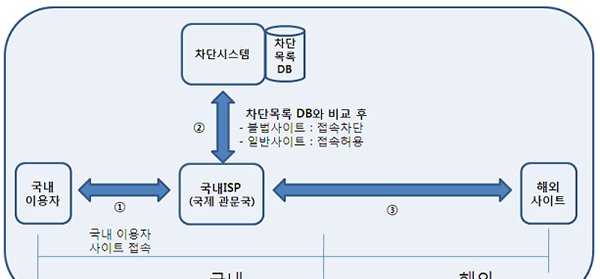
HTTPS encrypts most of a web session. In a standard TLS connection, however, the requested hostname may appear in the Server Name Indication, or SNI, field during the opening handshake. A network operator can therefore identify the destination domain without reading the page itself. South Korea added SNI-based filtering to earlier access-control methods in 2019. On February 11, the former Korea Communications Standards Commission requested that KT and nine other providers restrict access to 895 overseas websites. The system compared the exposed hostname with a block list and stopped matching connections.
SNI filtering does not necessarily inspect every image, message, or URL path inside an encrypted session. Claims that every block uses full Deep Packet Inspection or always redirects users to one warning page need separate evidence and should not be presented as universal facts.
In October 2023, South Korea’s Constitutional Court rejected a challenge to the measure. It found that the access-restriction request did not violate the constitutional rights raised and noted that providers could submit opinions, object, and seek judicial review. A failed connection does not prove that SNI filtering is responsible. The platform may have withdrawn from South Korea, blocked Korean IP addresses, limited its catalog by region, or changed its domain.
The Youth Protection Act and the Barrier of “Real-Name Verification”
The Youth Protection Act regulates media designated as harmful to young people. “Youth” generally means a person under 19, with a calendar-year exception for people who will turn 19 that year. The law includes sexual material in its review criteria while also requiring consideration of artistic, educational, medical, and social context.
Commercial online providers of youth-harmful media must prevent access by minors and use an approved method to confirm age and identity. The legal options are broader than the original article claimed:
- Face-to-face identification or an identity document submitted through an approved channel.
- A digital certificate or an identity method that does not directly use a resident registration number.
- Credit-card verification.
- Mobile-phone verification with additional confirmation.
- Another comparable method recognized by the responsible ministry.
These methods appear in the Enforcement Decree of the Youth Protection Act. It does not say every adult must use I-PIN, hold a Korean credit card, or provide a resident registration number in every case.
An overseas platform may not connect to Korean verification providers or build a separate compliance system for one market. That can create practical barriers for Korean users and foreign residents, but it does not make every unintegrated service automatically illegal. Age verification cannot legalize content classified as obscene or otherwise unlawful. Its purpose is different: keeping designated adult or youth-harmful media away from minors.

Decoding the 55% Block Rate and the Surge in VPN Usage
The claimed 55% block rate should be removed. The draft gives no source, date, sample, method, or definition of an “incoming request.” No official statistic identified for this review supports the claim that 55% of requests from South Korean IP addresses to foreign adult domains are blocked.
Domain-block counts cannot be converted into a percentage of user requests without traffic data. Thousands of listed URLs may receive little traffic, while one popular site may account for millions of attempts. The claim that South Korea ranks among the Asia-Pacific region’s highest VPN adopters is also unsupported. Even a verified adoption rate would not prove adult-content blocking is the main cause.
VPNs are used for work, travel, privacy, gaming, and accessing services available only in certain regions. Without a reliable survey, these uses cannot be reduced to one explanation. A VPN may change how traffic is routed, but it does not change the legal status of content. A factual article should explain the rules rather than build its argument around unverified circumvention claims.
The Role and Absolute Power of the KCSC
“Absolute power” is inaccurate, and the organization’s name is outdated. On October 1, 2025, a new law replaced the Korea Communications Standards Commission with the Korea Media and Communications Standards Commission. The successor inherited its duties, so older reports and court decisions still use “KCSC.” The current Standards Commission reviews online information covered by Article 44-7 and may request corrective action from communications providers. For an overseas site that does not respond to a removal request, domestic access restrictions can be the most practical enforcement measure. The process is administrative and does not require a prior court blocking order in every case. That gives the commission substantial influence, but not unchecked power.
The law provides procedures for deliberation and allows affected parties or their representatives to state an opinion in relevant cases. Courts have also treated correction requests by the former KCSC as administrative dispositions that may be challenged through administrative litigation. Legitimate criticism can focus on transparency, proportionality, notice, and the burden of challenging a block. Calling the regulator “absolute” ignores statutory procedure and judicial review.
Will South Korea Ever Shift Toward International “Platform-Level Age Verification”?
There is no single international model. Some jurisdictions are placing stronger duties on platforms, but that does not mean they have abandoned other enforcement tools. The European Commission has released a privacy-focused blueprint that lets users prove they are over 18 without sharing unrelated personal information.
Its child-protection guidance also calls for accurate, reliable, robust, and non-intrusive age assurance for adult content. In the United Kingdom, services that publish pornography must use “highly effective” age assurance under the Online Safety Act.
This is a platform obligation backed by regulatory enforcement, not proof of a universal shift away from network restrictions. South Korea could adopt more privacy-preserving verification while keeping blocks against unlawful content. Its current framework still lets the Standards Commission review prohibited information and request corrective action. No verified policy reviewed here announces that SNI blocking will be replaced by a platform-only system.
Predictions based on voter ideology, parent groups, or one criminal case are too speculative for a factual SEO article. Any reliable forecast should be based on published bills, ministry consultations, commission notices, and court decisions.
Overseas adult media services are not blocked merely because they are foreign or lack a Korean rating. Restrictions usually involve obscenity law, youth-protection rules, administrative review, and the difficulty of enforcing Korean decisions against operators abroad. SNI filtering lets domestic providers stop a connection by identifying the requested hostname before the encrypted session begins.
Age verification addresses a separate issue: preventing minors from accessing restricted media. Neither system makes every foreign adult platform illegal by default. The 55% statistic, the regional VPN ranking, and the description of the regulator’s power as “absolute” lack adequate support. The former KCSC has also had a successor commission since October 2025. For readers, the practical distinction is simple. An age prompt usually comes from platform compliance. A regional message may come from the service itself. A domain blocked across local networks may reflect an ISP restriction requested by the regulator. Those cases should not be treated as the same problem.